






In the world of modern infrastructure, container orchestration a core necessity. Whether you are running microservices, batch jobs, or legacy workloads, you need a system that can automatically schedule, scale, and heal your applications. There are two solutions that dominate the scene: Kubernetes (often abbreviated K8S) and HashiCorp Nomad.
As of 2026, Kubernetes continues to dominate with roughly 82% adoption in production environments across enterprises, according to recent CNCF and industry surveys.[1] It is the default choice for most large-scale, container-first organizations, and given the volume of articles and documentation about Kubernetes, one might assume it is suitable for any situation. But it is not the only option on the market.
Nomad has carved out a dedicated and growing niche, especially among teams that prioritize simplicity, workload diversity, resource efficiency, and lower operational overhead. Recent benchmarks show Nomad delivering up to 20% lower request latency and dramatically lower infrastructure costs (sometimes 3.6x cheaper than managed Kubernetes like EKS) in small to medium-sized deployments.[2]
This article provides a comparison to help you decide which tool aligns best with your team size, workload mix, existing ecosystem, and long-term goals. We will cover history, architecture, strengths/weaknesses, and a practical decision framework.
A brief history and design Philosophies
Nomad, launched by HashiCorp in 2015, is a flexible, lightweight workload orchestrator inspired by the desire for a “simple enough” scheduler. It can handle Docker containers, non-containerized applications, microservices, and batch applications across a wide range of environments, from on-premises data centers to cloud platforms. It focuses on scheduling and placement while intentionally excluding networking, secrets, storage, and service discovery. Note that in early 2025, IBM acquired HashiCorp, integrating Nomad more deeply into its enterprise hybrid-cloud and edge offerings. This has not changed its lightweight core DNA, but it has strengthened enterprise support and integration.
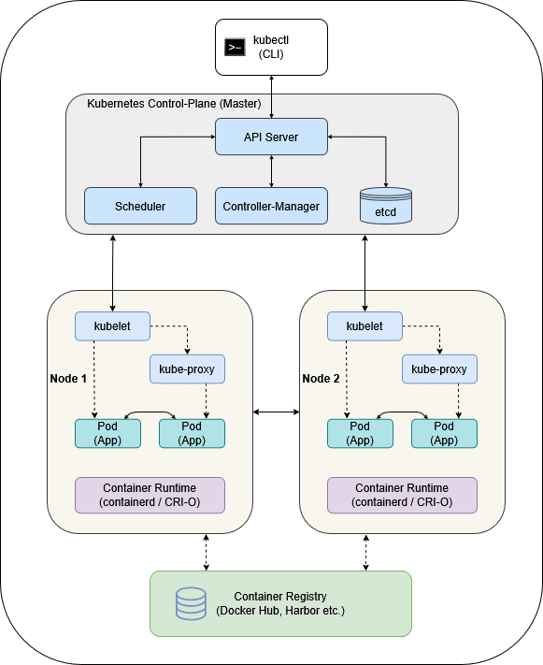
Kubernetes is a full-fledged container platform, originally built at Google. Released in 2014 and donated to the CNCF (Cloud Native Computing Foundation) in 2015, evolved into the industry-standard solution for large-scale, cloud-native deployments. It uses a distributed control plane (API server, etcd, controller manager, scheduler, kubelets, etc.) to manage everything from networking to storage. This rich feature set makes it incredibly powerful, but it also comes with significant complexity.
Rivalry
Both Nomad and Kubernetes are designed to schedule and run container workloads, but the fundamental differences between them extend far beyond their basic architectures. At a high level, the ‘rivalry’ is philosophical.
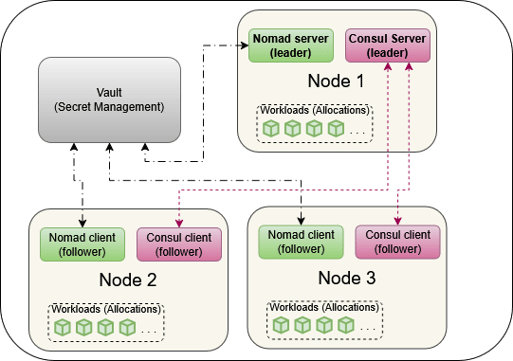
Nomad’s design is intentionally focused on minimalism and simplicity: it handles scheduling and resource management as a single binary without external data stores, and relies on tools like Consul and Vault for service discovery and secrets. This straightforward architecture reduces operational complexity and makes Nomad easier to set up and troubleshoot.
Kubernetes, in contrast, operates with multiple independent components: API server, etcd for state management, controller manager, scheduler, kubelet on each node, etc. This distributed architecture provides greater flexibility and feature richness, but that also comes with higher complexity. Managing Kubernetes requires an understanding of its multiple components and configuration options.
In short, Nomad embraces a Unix-like philosophy of doing one thing (scheduling) well and integrating with other tools, whereas Kubernetes offers an all-in-one orchestrator with a vast feature set.
Another key difference is how they treat workloads. Kubernetes takes a container-first approach, with pods as the pillars of its core abstraction, providing sophisticated pod-level constructs (affinity rules, taints/tolerations, custom controllers) for fine-grained placements. Nomad is more workload-agnostic: containers are just one of several supported task types. You can run Docker containers, raw binaries, JVM applications, virtual machines (via QEMU), batch jobs, etc., all under one scheduler. This flexibility can be a major advantage in environments with mixed, modern, or legacy applications.
Nomad advantages
- Minimal architecture, easy setup
Nomad runs as a single binary (per client or server) and does not require any external services for storage or coordination. There is no separate master or etcd cluster to maintain. In practice, this means that Nomad can be deployed and managed with very little overhead. You just download the binary and start it. The result is lower operational complexity and faster onboarding. - HashiCorp Ecosystem
Nomad is designed to integrate seamlessly with Terraform, Consul, and Vault for provisioning, service discovery, and secret management. If your organization already uses Consul/Vault, Nomad slots naturally into that ecosystem, providing coherent workflows for networking and credentials. This triad “Nomad+Consul+Vault” means you can get service discovery, dynamic configuration, and secrets without learning or introducing new systems. In effect, you leverage familiar HashiCorp tools rather than reinvent those capabilities. - Multi-workload support
Unlike Kubernetes, Nomad natively orchestrates more than just Docker containers. It can schedule Linux or Windows binaries, JVM apps, batch jobs, or even virtual machines (via its QEMU driver). Thanks to its driver system, you can run legacy services or specialty workloads alongside containers on the same cluster. This is valuable if you are gradually migrating to containers or need a single control plane for diverse workloads. - Resource efficiency and density
Nomad uses bin-packing to efficiently schedule jobs based on declared resource needs (CPU, memory, disk, etc.). You describe a job spec, and Nomad efficiently allocates workloads to optimize resource utilization. These decisions are made quickly using straightforward constraints. This simplicity can be a plus: the learning curve is gentle, and behavior is predictable. (Note: Kubernetes does offer advanced scheduling policies like taints, affinity rules, and custom schedulers for maximum control, but those add complexity.) - Lightweight and resource-efficient
Nomad is known for being lightweight and resource-efficient, capable of scaling tens of thousands of nodes with a minimal footprint. A Nomad cluster can often operate with low per-node overhead, making it attractive for edge computing or environments where resource conservation is important. It is also ideal for smaller setups. - Intuitive mental model
A Nomad job file specification is concise and readable. Example structure (simplified HCL):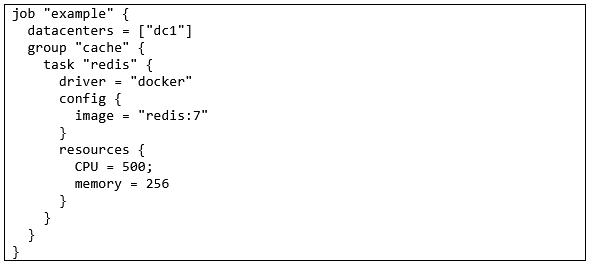 The flow (job → group → task → allocation) is straightforward compared with Kubernetes’ many resource types.
 - Proven scalability
Nomad has demonstrated production clusters exceeding 10,000 nodes and has completed public benchmarks with millions of containers. Its architecture shines in multi-region, multi-cloud, and edge scenarios. Teams describe Nomad as “boring in the best possible way” – reliable, predictable, and low-maintenance. - Cross-platform support
Nomad runs on macOS, Windows, and Linux. This flexibility reduces the barrier to adoption across teams with mixed operating systems.
Kubernetes advantages
- Mature ecosystem and large community
There is an enormous community and ecosystem around it, which means people have already faced a large number of problems and built solutions or shared examples online. Everything from helm charts for packaging apps, to certified networking and storage plugins exists, making it highly customizable and adaptable to diverse needs. Documentation, training courses, and third-party support are abundant. If your team needs a vibrant ecosystem and lots of community-tested tools (CI/CD, monitoring, logging, security scanners, etc.), Kubernetes delivers. This is how Kubernetes has become the industry standard for container orchestration. - Advanced networking and load balancing
Kubernetes provides a richer networking model out of the box. Each pod gets its own IP address, and the built-in service and DNS abstractions automatically load-balance traffic across pods. You can use Ingress objects or Service meshes (Istio, Linkerd) for advanced routing, and support pluggable CNI network providers (Calico, Cilium, Flannel, etc.). Critically, Kubernetes has NetworkPolicy APIs that let you write firewall-like rules between pods and namespaces. This fine-grained network control is useful in multi-tenant or sensitive environments. - Fine-grained RBAC security
Kubernetes implements robust Role-Based Access Control for the API. You can define ClusterRoles and Roles with specific permissions (verbs on resources) and bind them to users, groups, or service accounts. This lets admins grant exactly the privileges needed. For example, one team could be allowed to `get/list` pods but not create or delete them or be restricted to a single namespace. Without it, every admin token is a loaded gun. - Managed services everywhere
EKS, GKE, AKS, OpenShift, and dozens of distributions make it easy to run at enterprise scale without managing the control plane yourself. - Autoscaling and resilience features
Kubernetes has built-in automation for scaling and self-healing. The Horizontal Pod Autoscaler (HPA) can automatically add or remove replicas of a deployment based on CPU or custom metrics, and cluster autoscalers can provision nodes in a cloud. During a traffic spike, Kubernetes can scale out by replicating pods to meet demand. - Rolling updates and rollbacks
Kubernetes also has robust primitives for zero-downtime upgrades (rolling updates/rollbacks) and will automatically restart or reschedule failed pods, helping maintain uptime. This ensures a smooth transition and allows you to monitor the new version’s performance.
Use Cases and Decision Guide
When to choose Nomad
Nomad shines if you value simplicity, need to handle mixed workloads, or have limited resources. Smaller teams or edge deployments often choose Nomad because it can be stood up quickly (with a single binary) and managed without significant ops overhead. It works well in multi-cloud or hybrid scenarios due to its agnostic scheduling. Cloudflare’s edge platform is a real-world case: they use Nomad to orchestrate both containerized services and other workloads across thousands of locations, benefiting from Nomad’s lightweight and flexible model. In short, if you have a heterogeneous environment or want minimal ops overhead, Nomad is worth considering.
For example, for one of our customers in the enterprise document processing and workflow management domain, we have implemented Nomad as the main orchestrator because their core application stack was still heavily dependent on Windows Server VMs and had no realistic short-term path to Kubernetes-native or Linux-containerized workloads. Together with Consul and Vault, Nomad allowed us to modernize around that constraint rather than fight it: we used it to move Solr from oversized Windows Server VMs to containerized deployments on Linux, orchestrate supporting services (auth, database, traffic management), and automate Windows application deployments through GitLab pipelines. As a result, infrastructure costs were reduced, deployment and upgrade times improved severalfold, manual operational effort dropped significantly, and the client gained a repeatable orchestration model without needing to rewrite a full application.
When choosing Kubernetes
Kubernetes is usually the default for cloud-native, container-centric use cases, especially at large scale. Large enterprises managing thousands of containers across many teams tend to favor Kubernetes. Its rich ecosystem provides solutions for logging, monitoring, policy enforcement, and more. Regulated industries (finance, healthcare, etc.) often choose Kubernetes for its extensive security and compliance tools (network policies, audit logging, RBAC integrations). If your application is a microservice architecture that needs sophisticated traffic routing (multiple ingress routes, service meshes) or dynamic autoscaling, Kubernetes’ built-in capabilities make it a strong choice. For instance, media or gaming companies have used Kubernetes’ autoscaling and self-healing to handle rapid traffic spikes without manual intervention. The trade-off is that Kubernetes has a steeper learning curve and requires more resources: its control plane is resource-intensive, and day-to-day ops often involve managing more components (Ingress controllers, CRDs, etc.).
In one of our projects with legacy infrastructure, microservices were deployed as RPM packages on shared servers, which forced developers to constantly coordinate deployment windows. Migrating to Kubernetes changed this entirely: applications were standardized with Helm charts, environment-specific configuration was decoupled through ConfigMaps, and deployments were made fully declarative. The bigger shift was operational. With ArgoCD managing a GitOps workflow, every engineer can spin up an isolated testing environment on demand and tear it down just as easily once done. No more shared staging contention, no manual config drift. This migration has drastically reduced team friction and unlocked true parallel testing, allowing multiple dev teams to test different versions of the same application simultaneously without cross-contamination. By leveraging the synergy of Kubernetes, Helm, and ArgoCD, we have eliminated environment contention and manual configuration errors, drastically accelerated our release velocity, and optimized our infrastructure footprint.
Decision Framework
How to Choose. Ask yourself these questions (in order):
- Workload diversity?
Heavy mix of containers + VMs + raw binaries or batch jobs → Nomad handles heterogeneous workloads without forcing everything into a container abstraction. Pure containerized microservices with no legacy runtime needs → Kubernetes model is a natural fit, and you lose nothing by its container-only focus. - Team size and ops tolerance?
Small/medium team without dedicated platform engineering → Nomad’s operational surface is significantly smaller. Dedicated platform/SRE team already running Kubernetes or willing to invest in it → the ecosystem payoff justifies the complexity; managed offerings (EKS, GKE, AKS) further reduce day-2 burden. - Existing tools?
Heavy Terraform/Consul/Vault investment → Nomad integrates natively and reduces context switching across the HashiCorp stack. Heavy Helm, ArgoCD, Flux, or cloud-native tooling investment, or existing CRD/operator workflows → Kubernetes is the path of least resistance; rebuilding that ecosystem around Nomad has real migration cost. - Scale and complexity?
Edge deployments, multi-region simplicity, or heterogeneous infrastructure → Nomad’s federation model is genuinely simpler. Large-scale microservices with complex networking requirements, compliance needs, or reliance on mature operators (databases, ML workloads, etc.) → Kubernetes has a deeper operator ecosystem that is hard to replicate elsewhere. - Cost sensitivity?
Self-hosted or cloud cost optimization is critical → Nomad’s leaner control plane typically wins on TCO. In the cloud at scale, managed Kubernetes (EKS, GKE, AKS) with Spot instances, autoscaling, and efficient bin-packing can match or beat Nomad once you account for the cost of running Consul and Vault alongside it. - Futureproofing?
You do not have to choose forever. Many teams start with Nomad for speed and migrate specific workloads to Kubernetes (or vice versa) as needed to evolve. Hybrid setups are increasingly common, and both tools are stable enough to commit to incrementally.
Final verdict
There is still no universal winner, nor should there be. Kubernetes remains the safe, feature-rich, ecosystem-dominant choice for most large enterprises and complex container-native platforms. But Nomad has quietly become the smarter choice for teams that prioritize velocity, simplicity, and multi-workload flexibility.
In an era of platform engineering, AI-driven workloads, and edge computing, the right orchestrator is the one that lets your team move fastest while keeping costs and complexity under control. Many forward-thinking companies are discovering that Nomad delivers exactly that for a surprising number of use cases.
Pick Nomad when you want the scheduler to get out of your way. Pick Kubernetes when you want the entire platform handed to you on a silver platter. Either choice will serve you far better than raw VMs or bare metal, and both will continue to evolve rapidly through 2026 and beyond.
by Andrei-Silviu Trufas
DevOps Engineer @ Yonder
References
[1] https://www.cncf.io/reports/the-cncf-annual-cloud-native-survey/
[2] https://www.researchgate.net/publication/397110448_A_Comparative_Analysis_of_Self-hosted_Nomad_and_Managed_Kubernetes_for_Container_Orchestration
Book your free
1-hour consultation session
Yonder offers you a 1-hour free consultation with one of our experts. This is for software companies and enterprises and focuses on any concerns or queries you might have.

STAY TUNED
Subscribe to our newsletter today and get regular updates on customer cases, blog posts, best practices and events.