







For most of my career, the people who knew the customer best were the people least able to show what they meant. They could describe a problem, map it on a whiteboard, maybe write it up. But turning what was on their mind into a prototype or a working proof of concept was someone else’s job. So they could not test their own hypothesis, and they could not sit down with a customer to find out whether it was really needed or even the right vision.
That has changed, and I don’t think most companies have caught up with what it means.
From a frustration to something you can click
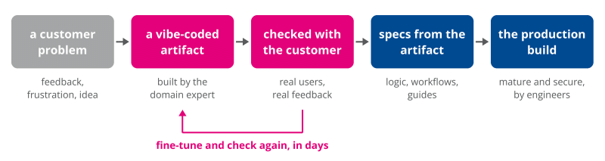
Customers have no shortage of challenges. Every conversation leaves a clue, something to take into mind: a complaint, a workaround, a “would be nice if”, a feature used in a way nobody intended. Mapping that challenge, opportunity, or requirement has become straightforward, and so has the next step. You can take customer feedback, treat it as an opportunity, and quickly turn it into a clickable prototype, a working prototype, or a simple POC for that exact situation.
It works for a brand-new feature, for recalibrating an existing one, for the slightest adjustment, and for something a bit more complicated. Ideas, frustrations, opportunities, or just a proactive hunch can become artifacts. And the intended users can check them quickly while the conversation is still fresh.
Where vibe coding earns its keep
The people who gain the most from this are not the engineers. They are the domain experts, the ones with years of customer knowledge and not much technical background, and we can finally use what they know.
Vibe coding is the black sheep of AI-driven development right now. But its principle is exactly what lets these people move fast. They can shape a solution around what they heard, saw, or spotted as an opportunity. And they can put it in front of a real customer, get feedback, fine-tune it, and take it to the point where it is ready to go into development. This is where I think vibe coding has its most value: not as a way to build the product, but as a way to find out what the product should be.
Every one of them hits the same ceiling
I have seen this before. At some point, the solution gets too complex. The user experience starts to suffer, and so does performance. It is definitely not secure, and so it is not production-ready.
But look at what it holds. A vibe-coded artifact like that carries all the requirements of yesteryear, the ones we used to capture in the traditional way. Before AI, getting there meant a complete spec sheet, detailed business logic, and visual workflows, and all of it took a lot of time and effort. Most of the time, even when everyone was happy with the documents, once it was coded and checked with the customer, it turned out not to be what you or the customer had in mind.
It already happened
We just had a case in one of our most important business verticals. A colleague from support vibe coded a solution for customers of one of our applications to automate a billing workflow they were doing manually. She did not stop at the prototype. She checked it with the customers, refined it with them, and took it far enough to open a paid beta. A few customers signed up and paid to be part of it from the start, before a single engineer had touched it.
Her solution has now reached the ceiling I described, and that is exactly where engineering comes in. It needs to mature and be integrated into the application and its delivery pipeline before it goes beyond beta.
Build it first, then write it down
Now the idea comes to life first as the artifact, and only then is it reverse-engineered into a detailed specification, business logic, and workflows, including visual ones. The same step covers the documentation, user guides, and guidelines. All of that becomes ammunition for your engineering department to build the solution properly, as a modern, mature, and secure product.
At Yonder, we like to say that good specs produce good code quicker. What changes here is the order. The spec is no longer the first thing you write. You first produce the artifact that maps everything, and the spec comes from it. You can also cross-check it against the existing code, which is easy even for a non-technical person: anyone with read-only access to the source code can do it. Put the artifact and the code together, and you have a robust set of specifications, business logic, workflows, documentation, and user guides, ready to go into production with specialized engineers.
Whether those engineers work with AI-DLC is a different topic, and one I want to come back to. But if they do, imagine what happens to speed and accuracy when this is where they start.
A small team with a long reach
The bottom line is enablement. The people who talk to your customers every day, product people, support colleagues, and customer-facing engineers, are sitting on the best requirements in the company. Coach them into this way of thinking, show them how simple the toolset really is, and let them create these artifacts together with the customer rather than for them.
The same goes inside the company. Internal departments such as HR, finance, and operations can design tooling for their own work, eliminate manual steps, and introduce automation. Their prototypes can evolve the same way, into internal applications that help the department that first imagined them.
That is how I see the future: a small team, call it a SWAT team, delivering new features and new functionality, adjusting what already exists, and removing what has become obsolete. This improves your applications so they get better, stay relevant, and are ready for the customers you will have next, not only the ones you have today.
By Mihai Diaconescu,
Delivery Manager @ Yonder
STAY TUNED
Subscribe to our newsletter today and get regular updates on customer cases, blog posts, best practices and events.
