







We organize this internal AI Week yearly to capture the most important lessons learned over the past year. Although we’ve been interested in AI since at least 2017, last September (when Sonnet 4.5 was launched) was a major turning point in the practical day-to-day usability of LLMs for development.
Paradigm shift
This is a paradigm shift, and the processes to support it haven’t caught up yet. Those claiming you only need a bunch of agents and one good developer on top of them clearly do not understand the engineering behind a complex, high quality product, and likely, haven’t tried to scale their vibe coded POC into a full blown product (unless they can convince their customers that a complete, consistent product isn’t necessary, and that it’s fine to use a bunch of small applications that look and feel different).
Realization
One interesting realization was that in Scrum/Agile, the cost of building is high enough that it’s better to start with a rough spec and iterate. LLMs invert that, implementation is so cheap that investing in a precise spec upfront yields far better results.
LinkedIn post by Remus Pereni,
Yonder CTO
Referring to Yonder’s post on its AI week:
On the second day of AI Week, we focused on preparing Yonder teams for a fundamental shift in how software is built, one already underway as AI and autonomous agents become embedded in everyday development workflows.
Rather than treating AI as just another productivity tool, Remus Pereni, Chief Technology Officer, framed it as a paradigm change that demands new workflows, new thinking, and new definitions of quality.
𝘛𝘰 𝘤𝘰𝘯𝘵𝘦𝘹𝘵𝘶𝘢𝘭𝘪𝘻𝘦 𝘵𝘩𝘪𝘴 𝘴𝘩𝘪𝘧𝘵, 𝘸𝘦 𝘵𝘳𝘢𝘤𝘦𝘥 𝘩𝘰𝘸 𝘵𝘩𝘦 𝘪𝘯𝘥𝘶𝘴𝘵𝘳𝘺 𝘦𝘷𝘰𝘭𝘷𝘦𝘥 𝘧𝘳𝘰𝘮 𝘢𝘭𝘨𝘰𝘳𝘪𝘵𝘩𝘮𝘪𝘤 𝘢𝘣𝘴𝘵𝘳𝘢𝘤𝘵𝘪𝘰𝘯 𝘵𝘰 𝘰𝘣𝘫𝘦𝘤𝘵-𝘰𝘳𝘪𝘦𝘯𝘵𝘦𝘥 𝘱𝘳𝘰𝘨𝘳𝘢𝘮𝘮𝘪𝘯𝘨, 𝘵𝘩𝘦𝘯 𝘵𝘰 𝘱𝘭𝘢𝘵𝘧𝘰𝘳𝘮𝘴, 𝘢𝘯𝘥 𝘯𝘰𝘸 𝘵𝘰 𝘈𝘐-𝘥𝘳𝘪𝘷𝘦𝘯 𝘢𝘣𝘴𝘵𝘳𝘢𝘤𝘵𝘪𝘰𝘯. 𝘛𝘩𝘦 𝘪𝘮𝘱𝘭𝘪𝘤𝘢𝘵𝘪𝘰𝘯 𝘪𝘴 𝘤𝘭𝘦𝘢𝘳: 𝘵𝘦𝘢𝘮𝘴 𝘤𝘢𝘯 𝘯𝘰 𝘭𝘰𝘯𝘨𝘦𝘳 𝘳𝘦𝘭𝘺 𝘰𝘯 𝘢𝘥-𝘩𝘰𝘤 𝘈𝘐 𝘶𝘴𝘢𝘨𝘦 𝘢𝘯𝘥 𝘮𝘶𝘴𝘵 𝘪𝘯𝘴𝘵𝘦𝘢𝘥 𝘦𝘮𝘣𝘳𝘢𝘤𝘦 𝘴𝘵𝘳𝘶𝘤𝘵𝘶𝘳𝘦𝘥, 𝘴𝘱𝘦𝘤-𝘥𝘳𝘪𝘷𝘦𝘯 𝘥𝘦𝘷𝘦𝘭𝘰𝘱𝘮𝘦𝘯𝘵, 𝘸𝘩𝘦𝘳𝘦 𝘤𝘭𝘦𝘢𝘳 𝘢𝘯𝘥 𝘥𝘦𝘵𝘢𝘪𝘭𝘦𝘥 𝘴𝘱𝘦𝘤𝘪𝘧𝘪𝘤𝘢𝘵𝘪𝘰𝘯𝘴 𝘣𝘦𝘤𝘰𝘮𝘦 𝘵𝘩𝘦 𝘱𝘳𝘪𝘮𝘢𝘳𝘺 𝘪𝘯𝘵𝘦𝘳𝘧𝘢𝘤𝘦 𝘣𝘦𝘵𝘸𝘦𝘦𝘯 𝘩𝘶𝘮𝘢𝘯 𝘪𝘯𝘵𝘦𝘯𝘵 𝘢𝘯𝘥 𝘈𝘐 𝘦𝘹𝘦𝘤𝘶𝘵𝘪𝘰𝘯.
We discussed methodologies such as Spec Kit, BMAD, and Specs.md, along with practical guidance on when and how to apply them. But the core message went beyond frameworks: 𝐀𝐈 𝐚𝐦𝐩𝐥𝐢𝐟𝐢𝐞𝐬 𝐡𝐮𝐦𝐚𝐧 𝐣𝐮𝐝𝐠𝐦𝐞𝐧𝐭. 𝐈𝐭 𝐝𝐨𝐞𝐬 𝐧𝐨𝐭 𝐫𝐞𝐩𝐥𝐚𝐜𝐞 𝐢𝐭. 𝐓𝐡𝐞 𝐫𝐞𝐚𝐥 𝐯𝐚𝐥𝐮𝐞 𝐨𝐟 𝐞𝐧𝐠𝐢𝐧𝐞𝐞𝐫𝐢𝐧𝐠 𝐭𝐞𝐚𝐦𝐬 𝐥𝐢𝐞𝐬 𝐢𝐧 𝐞𝐱𝐩𝐞𝐫𝐭𝐢𝐬𝐞, 𝐜𝐫𝐢𝐭𝐢𝐜𝐚𝐥 𝐨𝐯𝐞𝐫𝐬𝐢𝐠𝐡𝐭, 𝐚𝐧𝐝 𝐚𝐜𝐜𝐨𝐮𝐧𝐭𝐚𝐛𝐢𝐥𝐢𝐭𝐲, 𝐧𝐨𝐭 𝐢𝐧 𝐡𝐨𝐰 𝐟𝐚𝐬𝐭 𝐜𝐨𝐝𝐞 𝐠𝐞𝐭𝐬 𝐠𝐞𝐧𝐞𝐫𝐚𝐭𝐞𝐝.
The session introduced:
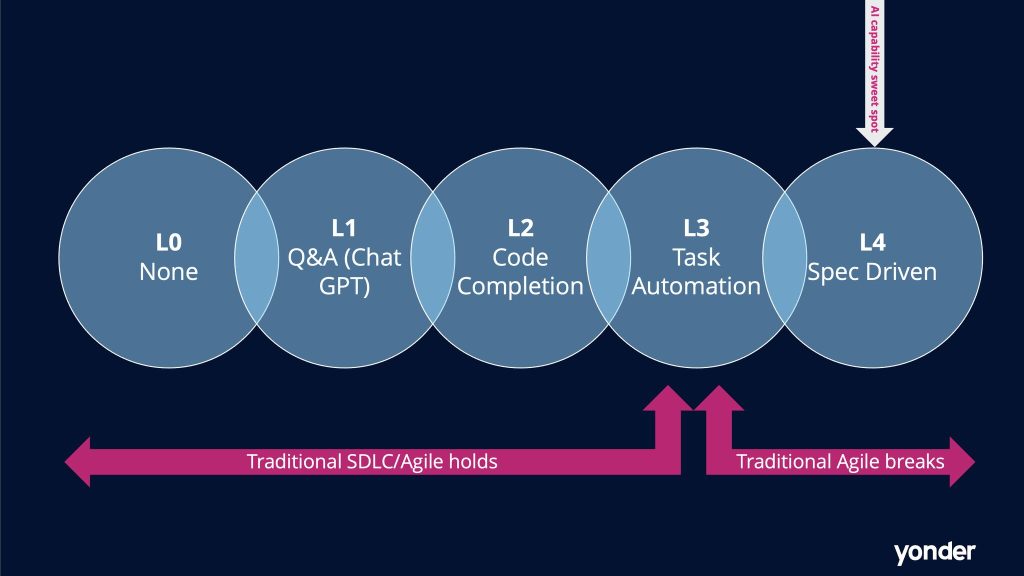
💡 A five-level AI maturity model for projects: from basic AI assistance to fully spec-driven development, where traditional Agile workflows start to break (see below 👇 )
💡 Evolving competency dimensions across seniority levels
💡 The transformation of traditional roles, from Product Owner to DevOps.
These are not abstract ideas. They reflect changes teams are already navigating.
By combining strategic vision with actionable frameworks, the session offered a practical roadmap for deliberately and safely adopting AI, ensuring that the speed AI enables does not come at the cost of delivery stability, architectural integrity, or long-term maintainability.
STAY TUNED
Subscribe to our newsletter today and get regular updates on customer cases, blog posts, best practices and events.
